
06 Apr 2026
Mobile app development in 2026 comes with its fair share of hurdles.
It’s no longer just about creating an app that works, it’s about ensuring your app delivers:
In fact, 21% of users never return to an app after their first use, according to a Localytics study. This highlights just how crucial it is to keep users engaged right from the start.
As the world of mobile app development becomes more complex, understanding these mobile app development challenges is essential to know what you’re up against.
But don’t worry, you’ve got this!.
This guide will walk you through the key challenges and offer practical solutions to help you create high-performing apps. Ready to get started? Let’s go!
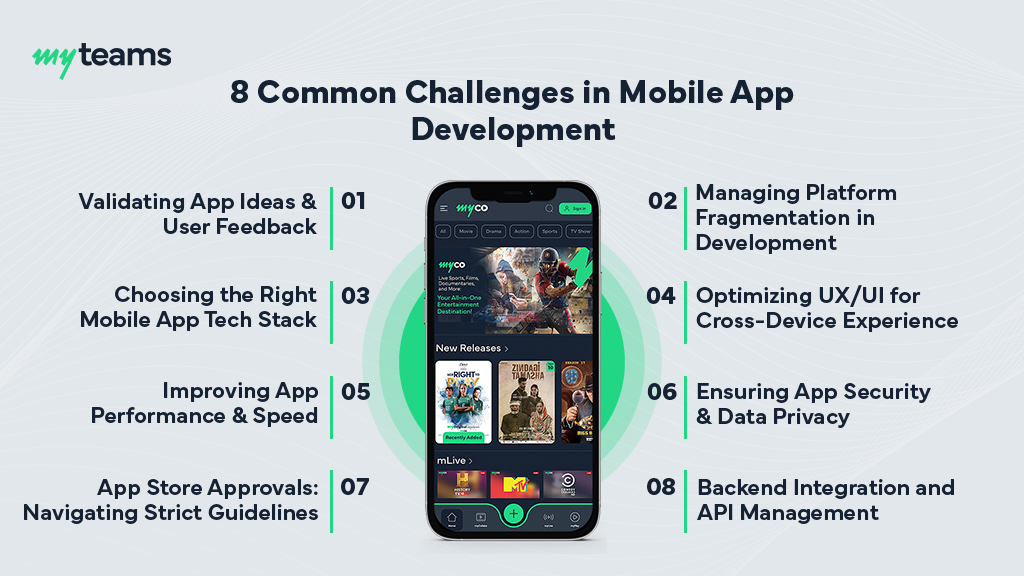
Building a successful mobile app in 2026 involves overcoming key challenges that affect performance, security, and user experience.
In this section, we’ll outline the 8 real challenges in mobile app development and provide practical solutions to help you tackle them effectively.
A huge number of app ideas fail because they don’t address a real problem or meet user expectations.
Without early validation, it’s nearly impossible to know if your app will truly resonate with users.
The challenge?
Identifying whether your app idea will succeed before investing time and money into development.
Don’t rush into development.
Start by doing market research and identifying real user needs.
Surveys and prototype testing can reveal how your app idea is received.
MVP (Minimum Viable Product) testing will help you get feedback early on, ensuring you make adjustments before diving into full-scale development.
One of the best ways to avoid the common pitfall of building an app no one wants is by validating your ideas early. A great example of this in action is HeleCare, a health-tech app we worked on that evolved from user feedback and early testing.
You can read the full case study and see how validating their app idea early helped them meet real healthcare needs.
With countless devices, operating systems, screen sizes, and hardware specifications, ensuring that your app works seamlessly on all platforms is a daunting challenge.
How do you make sure your app performs consistently across the wide variety of mobile devices and OS versions in the market?
Use responsive design to help your app adapt to different screen sizes.
Leverage cross-platform frameworks like Flutter or React Native to save development time and ensure your app works across both iOS and Android.
Don’t skip real-device testing, use cloud-based services like BrowserStack to ensure your app functions on a wide range of devices.
One of our clients made use of React Native to create a seamless experience across both iOS and Android. The app was built to handle varied device specifications and perform flawlessly. Learn how we helped them deliver on these challenges in our full case study here.
Choosing the wrong technology stack can lead to poor performance, scalability issues, and long-term maintenance problems.
Should you go native, hybrid, or cross-platform?
The wrong choice can cause headaches later on, affecting the app’s future growth.
When choosing a tech stack, consider your app’s goals, performance needs, and long-term scalability.
If you need access to deep device features and high performance, native development is ideal.
However, if cost efficiency and targeting multiple platforms are important, cross-platform frameworks like React Native and Flutter are great choices.
According to studies, 46% of developers prefer using cross-platform frameworks like React Native and Flutter to save time and reduce costs, reflecting the growing trend in mobile app development.
One of the biggest reasons users abandon apps is a poor user experience.
Whether it’s an unintuitive design, hard-to-navigate interface, or slow load times, these issues can drive users away quickly.
Balancing aesthetics with functionality to create a positive experience is a constant challenge.
Design with simplicity in mind, focus on clear navigation and minimalist interfaces.
Follow platform-specific design guidelines like Material Design for Android and Human Interface Guidelines for iOS to make sure your app feels right on each device.
Test your design with real users, collect feedback, and adjust to meet their expectations for both functionality and beauty.
If your app is slow to load, crashes often, or feels sluggish during use, users won’t hesitate to ditch it.
The tricky part is ensuring your app runs smoothly even under heavy usage, while also managing battery and memory consumption.
Balancing performance with efficiency is one of the toughest aspects of mobile development and plays a major role in keeping users engaged and satisfied.
To tackle this, implement caching to reduce load times and image compression to save space.
Use performance-monitoring tools to track and improve your app’s speed.
For battery efficiency, streamline background processes and minimize unnecessary updates.
The goal is to ensure your app is fast, responsive, and doesn’t leave users frustrated or drain their device’s resources.
Did you know that 53% of mobile users will abandon an app if it takes more than 3 seconds to load? That’s a huge impact on user retention, so it’s crucial to keep speed a top priority when developing your app.
Mobile apps are prime targets for cyberattacks.
A single data breach can compromise sensitive user information, destroy trust, and even land you in legal hot water.
With stricter regulations like GDPR and HIPAA, security isn’t just a nice-to-have; it’s a must.
To keep your app safe, start by using encryption (AES, RSA) to protect user data and follow OWASP security guidelines for secure coding.
Add multi-factor authentication (MFA) to make sure only authorized users access sensitive areas.
Regularly perform security audits and penetration testing to catch vulnerabilities before they become problems.
By adopting a security-first approach from the start, you’ll build an app that’s safe now and in the future.
Getting your app approved by the Apple App Store or Google Play Store can feel like running an obstacle course.
The approval process is strict, and apps often get rejected for reasons like policy violations, poor performance, or privacy concerns.
It’s a frustrating but necessary step if you want your app to go live.
To boost your chances of approval, make sure to thoroughly review the App Store and Google Play guidelines before submitting.
Conduct pre-submission testing to ensure your app performs well and meets all security standards.
Double-check that it complies with privacy regulations and that any third-party integrations are secure.
Use beta testing platforms to catch issues early and avoid any rejection surprises.
Integrating backend services and managing APIs can quickly become a headache.
If you’re working with multiple third-party services or dealing with large amounts of data, things can get complicated fast.
Poor backend integration can lead to slow response times, security vulnerabilities, and data inconsistencies, none of which are good for user experience.
Simplify backend management by ensuring your APIs are well-documented, secure, and efficient.
Tools like Swagger and Postman make it easier to test and manage your APIs.
Also, use API versioning to ensure your app runs smoothly even as you roll out new updates.
With a solid backend setup, you can ensure a seamless, reliable experience for your users.

Technology | Description | Impact on Mobile App Development |
5G Connectivity | The fifth generation of mobile network technology. | Boosts app speed, reduces latency, and supports more complex apps. |
Augmented Reality (AR) | Integrating digital information with the real world. | Enhances user experience, especially in e-commerce and gaming. |
Artificial Intelligence (AI) | Enables machines to learn and make decisions. | Personalizes user experience, automates tasks, and improves app intelligence. |
Blockchain | A decentralized ledger technology. | Improves security, enhances data integrity, and enables cryptocurrency features. |
Voice Recognition | Voice-controlled interactions and speech-to-text. | Provides hands-free functionality, improving accessibility and user engagement. |
The biggest challenges in app development include managing device fragmentation to ensure compatibility across various platforms, maintaining a smooth user experience, and addressing security concerns. Additionally, app store approval processes and optimizing app performance for speed and efficiency are also significant hurdles developers must navigate.
The world of mobile app development in 2026 presents exciting opportunities, but it also comes with significant mobile app development challenges.
From security to cross-platform compatibility, these hurdles must be tackled to ensure your app’s success.
By focusing on performance, user experience, and continuous optimization, you can build an app that stands out and thrives.
At MyTeams, our experts are ready to help you navigate these challenges and build high-performing, secure apps.
Contact us at info@myteams.co or call us at (512) 265-6881 to get started on creating your next great app!