
19 May 2026
Have you ever heard about a startup that poured resources into building a product, only to see it flop? 90% of startups fail, and one of the top reasons is the lack of market demand.
But what if there was a way to test your idea early, gather real feedback from users, and refine your product before going all in?
There’s an approach for that, the Minimum Viable Product (MVP).
It helps you start small, focusing on just the essential features to validate your idea, without wasting time or resources.
Not sure what an MVP is or how it works?
Don’t worry, we’ll dive into all the details.
Keep reading, and by the end of this guide, you’ll understand how this approach can help you reduce risk and ensure your product truly meets the needs of your market.
A Minimum Viable Product (MVP) is a simplified version of your product that includes only the essential features necessary to address the main problem your users face.
The goal of an MVP is to test whether your product concept works, without heavy investment in time or resources upfront.
Instead of developing a fully featured product, an MVP focuses on the core functionality needed to solve the problem and demonstrates whether users are interested.
By launching with minimal features, you can gather real-world data to determine if your idea is viable, and decide whether to move forward, pivot, or abandon it.
(Example: Start by launching a basic version of an app that tracks user activity before adding more complex features like personalized recommendations.)
(Example: Launch a landing page or an email sign-up form to gauge interest in your idea before committing to building the entire product.)
(Example: Share a prototype with a small group of users to get feedback on the design and usability, allowing you to make adjustments quickly.)
(Example: Offer a free version or trial to collect insights from early users on features they value most, helping you prioritize future updates.)
Eric Ries, the author of The Lean Startup, explains that the purpose of an MVP is not to deliver a final product but to test your business hypothesis with minimal resources.
An MVP helps you quickly assess whether your product idea resonates with users, minimize risks by gathering user feedback early, validating assumptions, refine the product and let you learn and adapt before fully committing to development.
Building an MVP isn’t just about developing a simple product, it’s about testing your assumptions, learning quickly, and adapting.
Here’s how to approach the core features of your MVP in a way that adds real value and allows you to build smarter:
Focus on core functionality.
This means stripping your product down to its simplest version that still offers enough value to users.
Ask yourself:
Any feature that doesn’t directly contribute to solving the user’s main problem should be eliminated at this stage.
Ensure that even in its simplest form, your MVP can perform the most essential tasks required to solve the user’s problem.
It doesn’t need to be feature-rich, but it should be reliable enough to engage users and provide value.
Your MVP should leave users thinking, “This works, but I’d love to see more.”
The Minimum Viable Product should be structured in a way that you can collect actionable data from real users.
Whether it’s through:
Make sure you can measure how well the MVP is performing against your theory.
The goal is to understand how users interact with the product, what they like, and where they encounter issues.
Identifying the core features of your MVP is key to its success.
Here’s how to approach it:
What is the core issue you’re solving? Identify the features that directly address this problem and leave out anything extra.
(Example: For an e-commerce platform, the core features may include browsing products, adding items to the cart, and completing a purchase. Anything beyond this, like wishlists or reviews, can come later.)
Think about how users will interact with your product.
Identify the critical steps they’ll take from start to finish, and make sure your MVP covers these key touchpoints.
(Example: If you’re creating a fitness app, the essential steps might be creating an account, selecting fitness goals, and tracking progress. You can add features like community challenges after validation.)
Determine which features will provide the most value and impact for your users.
Focus on the features that allow you to gather the most meaningful feedback to validate your assumptions.
(Example: If you’re building a news app, ensuring that users can easily browse articles and save favorites might be more important than adding personalized recommendations at first.)
By focusing on these core features, you ensure that your MVP remains lean and efficient, while still solving the user problem effectively.
There are two main types:
Both serve to validate your product idea, but they differ in terms of complexity, resources, and the depth of testing they offer.
Let’s break down each type and its sub-types to understand when and how to use them.
Low-fidelity MVPs are minimal, quick, and inexpensive methods to validate your product concept with real users.
They allow you to test your assumptions and gauge user interest without spending too much time or money upfront.
A landing page MVP involves creating a simple webpage that showcases your product idea or concept, with a clear call-to-action (e.g., email sign-ups or pre-orders).
This method helps you quickly assess user interest without having to build the full product.
In a fake door MVP, you create a product or feature page that seems to be live but doesn’t actually exist yet.
When users click on it, they get a message that the feature is “coming soon.”
This allows you to measure the level of interest before building the feature.
This MVP involves running marketing campaigns (ads, social media, etc.) to gauge interest in your product idea.
You can use ads or email campaigns to test whether people are willing to engage or purchase, even before the product is built.
An email campaign MVP uses a series of emails to test product interest, gather sign-ups, or even offer early access to potential users.
It’s a simple, low-cost way to test if people are ready to engage with your product.
A pre-order MVP offers customers the chance to purchase your product before it’s fully developed.
This helps test demand and shows whether customers are willing to commit to a product in advance.
An explainer video MVP is a simple video that explains your product idea and its value proposition.
This allows you to assess user interest before building the full product, using just a video to communicate the concept.
High-fidelity MVPs offer a more refined, functional version of your product, often with working features and more attention to detail.
These are ideal for testing user behavior, feature usability, and gathering more accurate assessment before scaling your product.
A single feature MVP focuses on developing just one core feature of your product to validate its value with users.
It allows you to test the most important part of your product before adding additional features.
Example: A fitness app might initially offer just a workout tracker to see if users engage before adding additional features like meal planning or community support.
In a piecemeal MVP, you combine existing third-party tools or services to create a functioning product without building everything from scratch.
This allows you to test your idea quickly and cheaply using existing solutions.
A concierge MVP involves manually providing the service or experience that the product will eventually automate.
This helps you validate whether users actually need or want the product before you fully automate it.
In the Wizard of Oz MVP, the product seems automated, but a person is manually running the backend processes behind the scenes.
This gives users the illusion of a fully functional product while you test its effectiveness.
A Crowdfunding MVP is unique because it can be either low-fidelity or high-fidelity depending on how you approach it.
Crowdfunding platforms like Kickstarter or Indiegogo allow you to present your product idea to a wide audience to validate demand and secure funding.
Crowdfunding can be a great way to validate demand, secure early adopters, and raise funds for development.
Feature | Low-Fidelity MVP | High-Fidelity MVP |
Purpose | Quick, cost-effective validation | Realistic user testing |
Development Time | Shorter, minimal | Longer, more detailed |
Cost | Low | Higher |
Features | Core features only | Full features with more polish |
Risk | Low risk of over-investment | Higher risk if misaligned with user needs |
Building an MVP is about collaboration, feedback, and creating something that aligns with user needs.
Here’s a streamlined process to guide you:
Understand the core problem your product addresses and ensure your MVP focuses on solving it effectively.
This step is key to making sure you’re solving the right problem for your users.
Don’t just build for users, co-create with them, ensure your web development team is involved in the iterative process from the start.
Involve users from the start and treat them as co-creators, encouraging response throughout the process.
This ensures your MVP evolves based on real-world input.
Focus only on the essential features that validate your assumptions about the problem you’re solving.
Don’t overcomplicate the MVP; prioritize what’s necessary to test your hypothesis and get feedback, not a polished product.
Remember, an MVP doesn’t need to be perfect.
Launch something scrappy and imperfect.
Your MVP doesn’t have to be refined; it just needs to function and provide value.
This “ugly” MVP mindset allows you to test fast and learn quickly without wasting time on features that might not resonate with users.
Feedback isn’t just data; it’s a tool for growth.
Act on user critiques quickly to refine and improve your MVP.
Each feedback loop should trigger actionable changes that move the product forward.
Instead of only validating features, test the core assumptions about your market and users.
This will help you ensure that you’re addressing the right problem with the right solution.
Use constraints as a tool to focus on what truly matters.
Build the MVP within limitations that force creativity and prioritization.
Note: Constraints help you focus on core features, avoiding unnecessary complexity and wasted effort.
When MyTeams first connected with Myco, they were still a bold idea in the making, not yet the global streaming platform they are today.
The founder had a vision to create something innovative:
“A platform that not only streamed content like live sports, TV, and movies but also offered Web3-powered rewards to users for their participation.”
However, before building out the entire platform, they needed to validate the idea and test if users would actually engage with it.
The idea wasn’t just to build another streaming platform, but to create an experience where users could: watch content, earn rewards, and even own a piece of the platform.
The goal was to combine traditional media with the power of Web3.
But before diving into full-scale development, Myco needed to see if real users cared about the concept and if it could resonate with the audience.

We decided to start with a “Landing Page MVP.”
It was a simple, focused approach to test the concept without any heavy investment upfront.
The page would clearly explain:
The landing page did exactly what it was meant to do, gauge user interest.
This approach helped us see if people were genuinely interested in the concept and gave us the chance to gather real feedback, without building the whole product upfront.
By tracking:
We were able to measure real demand for the idea.
Instead of making assumptions, we could see actual responses from users, which gave us the confidence that the concept was worth pursuing further.
As soon as the feedback started rolling in, it was clear where we needed to tweak things.
We could easily see what users cared about most, and that helped us focus on refining the messaging and prioritizing the features that would make the biggest impact.
With this real feedback, we were able to move forward with confidence and avoid wasting time on things that didn’t matter.
What started as a simple MVP quickly evolved into a fully functional platform, reaching millions of users across different regions.
The MVP wasn’t just about confirming our idea; it was a chance to learn and adapt in real-time, reflecting the principles of total experience design where user feedback drives every decision.

Driven by user feedback and constant iteration, myco has grown into a full-scale entertainment platform serving millions globally.
The MVP taught us so much. It wasn’t just about validating the idea; it was a chance to learn and adapt in real-time.
Starting small and gathering real feedback helped us iterate fast, dodge mistakes, and build something that really fit the market.
It proved how important it is to test ideas early, listen to users, and grow based on actual insights.

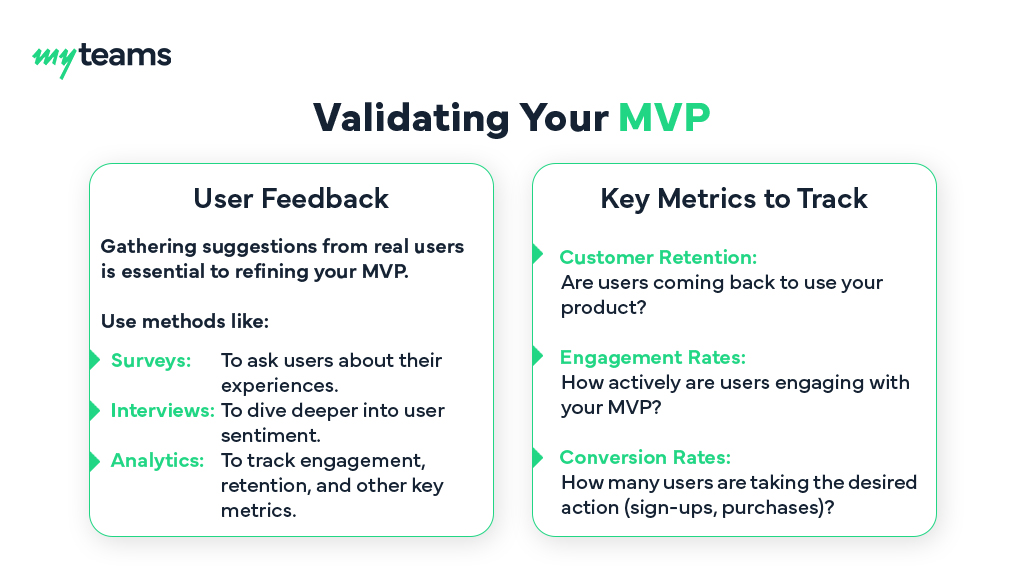
The MVP’s purpose is to validate your product idea with the least amount of effort and resources. It helps you test assumptions, get user feedback, and learn what works before committing to full-scale development.
To test an MVP, focus on collecting feedback through surveys, interviews, and analytics. Track key metrics like engagement, conversion, and retention to see if users are interested in your product and if it addresses their needs.
An MVP is a functional product used to gather feedback and validate assumptions. A Proof of Concept (PoC) is a smaller-scale prototype used to test the feasibility of an idea or concept, typically before building an MVP.
When it comes to building a product, the Minimum Viable Product (MVP) is your best friend.
It’s all about testing your ideas, getting real user feedback, and making sure you’re heading in the right direction without wasting valuable time or resources.
By focusing on the essentials in your app development, you can create a product that truly speaks to your audience.
At MyTeams, we’ve helped many businesses in turning ideas into products that work.
If you’re ready to test your product idea and get it right the first time, our team is here to help.
Drop us a line at info@myteams.co or give us a call at (512) 265-6881, we’d love to chat and help you take that first step!