10 Jul 2025
If you are exploring modern web solutions, you might be wondering what is the MERN stack, and why it’s gaining traction among businesses.
It’s a proven full-stack framework that leverages JavaScript at every layer to deliver robust, scalable web applications. The MERN stack is a collection of four key technologies used together to build dynamic web applications. MERN stands for MongoDB, Express, React, and Node.js; a combination of a database, a server framework, a front-end library, and a runtime environment.
All components in a MERN stack use JavaScript, enabling a unified development approach from the client-side to the server-side. This uniformity streamlines development and makes MERN a popular choice for startups and enterprises seeking fast, scalable solutions.
MERN stack architecture in action.
A user’s request travels from the React front-end to the Node/Express back-end, then to the MongoDB database, and back again, updating the UI once the data is processed.
Understanding what is MERN stack in practice comes down to seeing how its components interact. The MERN stack works as an end-to-end framework that handles everything from the browser to the database. Here’s a simplified look at how it operates:

The MERN journey begins in the browser. React.js is the front-end library for building rich user interfaces. It structures the application into reusable components, enabling dynamic and responsive UI updates. React uses a virtual DOM to efficiently re-render only parts of the page that change, making the app feel fast and interactive. For a business, this means a smooth user experience that can improve customer engagement.
When a user interacts with the interface, React sends requests to the server. This is where Node.js (a JavaScript runtime) and Express.js (a web application framework) come into play. Node.js runs on the server to handle requests using JavaScript, so your team uses one language throughout the stack.
Express sits on top of Node to manage the application’s back-end logic and routing. It handles tasks like defining API endpoints, processing form submissions, and communicating with the database. Express is lightweight but powerful, it routes HTTP requests and responses, enforces middleware logic, and makes it straightforward to build RESTful APIs. With Node’s non-blocking, event-driven architecture, the MERN stack backend can handle many concurrent connections, which is great for scalability and real-time applications.
Whenever data needs to be stored or retrieved, the request is passed to MongoDB, the MERN stack’s database. MongoDB is a NoSQL database that stores data in flexible JSON-like documents rather than rigid tables. This pairs perfectly with JavaScript and Node, because the data format (JSON) is uniform from browser to server to database.
In practice, this means the data submitted from a React front-end can travel through Express/Node and be saved in MongoDB without needing heavy conversion. MongoDB’s flexible schema and scalability are ideal for applications that need to handle large volumes of data or adapt to changing requirements. For example, if you’re building an e-commerce site or a social network, MongoDB can easily accommodate evolving data models on the fly.
When researching what is MERN stack, you’ll often come across the MEAN stack as a close cousin.
Both MERN and MEAN share three core technologies – MongoDB, Express, and Node.js – and differ only in the front-end framework. MERN uses React, while MEAN uses Angular. This one swap leads to notable differences in how each stack serves project needs. Here’s how they compare:
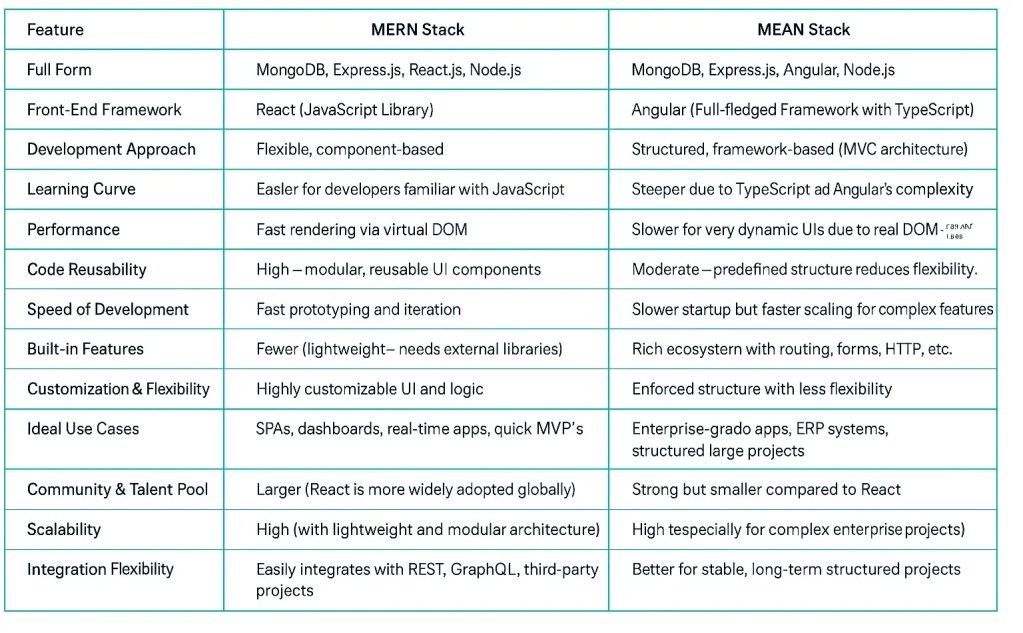
Many teams find React’s approach more lightweight and adaptable, especially for user-facing apps where requirements can change quickly. In fact, developers who prioritize flexibility and innovation tend to lean toward the MERN stack, whereas those who require strict structure for large-scale applications might favor MEAN.
For scaling your team and project, it’s worth noting React’s popularity: React has a larger community and talent pool (about 50% more popular than Angular by some metrics), meaning it might be easier to hire developers for MERN projects. Angular is still widely used (especially in enterprise environments), but the broader adoption of React gives MERN a hiring and community support advantage.
Knowing what is a MERN stack is only part of the story. The next question is when it’s the right tool for the job. Here are scenarios and project types where choosing the MERN stack makes strong business sense:
Now that we know what is MERN stack and when it excels, let’s highlight why businesses choose the MERN stack over other options. These are some key benefits and business advantages of going with MERN:
One way to appreciate the MERN stack is to look at the types of solutions and applications that are commonly built with it. Because MERN is flexible and robust, it’s used in a wide range of web solutions, from small single-purpose apps to large enterprise systems. Below are some categories of projects ideally suited for MERN:
Popular web development stacks and their ideal use cases. MERN is well-suited for dynamic single-page applications, dashboards, and any solution needing fast development with JavaScript across the stack.
Nothing speaks to a technology’s value better than real-world success stories.
To further understand what is MERN stack capable of, let’s look at three fantastic real-world examples of companies and platforms that have utilized the MERN stack (or its components) in their development. These examples span different industries, showing how versatile and powerful MERN can be in practice:
Facebook (Meta Platforms)
Facebook is famously the originator of React, and it effectively became the first major user of the MERN approach for front-end development. In Facebook’s web application, React enables the highly dynamic user interface. Think of the constantly updating news feed, comments, likes, and chat features that update without full page reloads. On the server side, Node.js and Express have been used by Facebook and other Meta services to build performant web services.
The robustness of the MERN stack (with React at its core) is credited as one reason Facebook can deliver a smooth experience to billions of users. Instagram and WhatsApp, also part of Meta, are mentioned as MERN stack success stories as well. These platforms use React for their web versions and have experimented with Node.js services to handle the massive scale of users. The takeaway: MERN’s components can support applications with enormous user bases and real-time interaction needs.
Airbnb
Airbnb, a global travel marketplace, has also leveraged MERN stack technologies to build its platform. Airbnb’s web application uses React for its front-end, providing a rich interactive interface for searching maps, filtering properties, and managing bookings. By using React (MERN’s front-end library), Airbnb delivers real-time updates. For example, if a new property becomes available or a price changes while you’re browsing, the UI can update without requiring a page refresh.
On the back end, Airbnb has used Node.js services to handle API requests and manage data, alongside databases including MongoDB for certain features. This use of MERN components has extensively increased Airbnb’s application traffic handling capacity, as the dynamic stack can serve a large number of user requests efficiently. For a business like Airbnb, which must seamlessly connect millions of hosts and guests worldwide, MERN offers the performance and scalability to keep the platform running smoothly. The optimized user experience including fast load times, interactive maps, instant updates owes a lot to MERN’s capabilities.
Uber
On-Demand Ride Sharing: Uber’s platform is known for real-time updates (seeing your car approach on the map, live ride status, etc.), and the company has utilized elements of the MERN stack to achieve this. Uber’s engineers have built parts of their web-based dashboards and booking systems with React for the front-end and Node.js/Express for the back-end, ensuring that the interface updates quickly as data changes.
According to case studies, Uber found Node.js particularly effective for handling the massive number of API calls and real-time connections in their system. The MERN stack’s scalability allowed Uber to combine live location sharing, secure user data handling, and multiple user role interfaces (rider, driver, admin) in one coherent system.
For example, when a rider requests a ride, that event goes through an Express/Node backend to match with drivers, uses MongoDB (among other databases) to store ride details, and then updates both the driver’s and rider’s React-based interfaces in real time to show the ride status. Uber’s success demonstrates how MERN can be used to create scalable, feature-rich applications that respond instantly to users – a critical requirement in the competitive on-demand services industry.
Struggling with slow product launches, messy codebases, or poor scalability?
MyTeams helps you cut through the noise with expertly built MERN stack applications customized for startups and scale-ups alike, in collaboration with the top 1% MERN developer talent.
From MVPs to enterprise-grade platforms, we help you deliver faster, smoother, and smarter web solutions.
Here’s what we bring to your table:
Ready to turn your app idea into a high-performing product? Let’s build your next MERN-powered solution.
These examples highlight that the MERN stack is battle-tested in high-profile, high-traffic environments. From social media giants to global marketplaces and real-time services, MERN has proven its worth.
Of course, not every business is as large as Facebook or Uber, but the same qualities that served these companies – fast development, flexibility, scalability, and excellent user experiences – are the ones that can benefit your project too. By understanding these examples, you should not only grasp what is the MERN stack in theory, but also see how it delivers tangible business value in the real world.