MyTeamsFinalLogo
MyTeamsFinalLogo
What is React JS | MyTeams

What is React js & Six Benefits Of Using It For Web Development

By - MyTeams Editorial

Apr/28/2025

Table of Contents

React.js has revolutionized how developers build user interfaces for the web. Designed for speed, efficiency, and scalability, React offers a modern approach through its component-based architecture and virtual DOM.

From small websites to large enterprise platforms, React powers some of the world’s most dynamic applications. Let’s explore what is React js, the benefits it offers businesses, and why its so essential today.

What is React js?

React.js is a popular open-source JavaScript library used for building fast, dynamic, and interactive user interfaces, especially for single-page applications. Developed by Facebook, 

React uses a component-based architecture, allowing developers to break UIs into small, reusable pieces. It updates the UI efficiently using a virtual DOM, ensuring high performance even as applications grow complex. 

React promotes a declarative programming style, making code more predictable and easier to debug. Today, it powers some of the world’s largest web platforms, from social media sites to enterprise apps. 

You can download React js from the official Github repository. 

Core Concepts Behind React.js

React.js is built on a few powerful core ideas:

  • Component-Based Architecture:
    React breaks the UI into small, reusable pieces called components. Each component controls its own layout, style, and logic, making the code easier to manage.

  • Props (Properties):
    Props are used to pass data from a parent component to a child component. They make components flexible and customizable without changing their internal logic.

  • State Management:
    State is dynamic data that a component manages itself. When the state changes, React automatically updates the relevant parts of the UI to reflect the change.

  • Virtual DOM:
    Instead of working directly with the browser’s DOM (which is slow), React creates a lightweight virtual DOM. It compares versions and updates only what’s needed, making apps faster.

  • Unidirectional Data Flow:
    Data in React flows in a single direction — from parent to child components. This approach makes apps easier to understand, debug, and maintain.

6 Benefits of Using React.js for Web Development

React.js has become a favorite for developers and companies around the world because of its powerful advantages. Whether you’re building a small website or a large enterprise application, React offers features that make development faster, more organized, and more scalable.
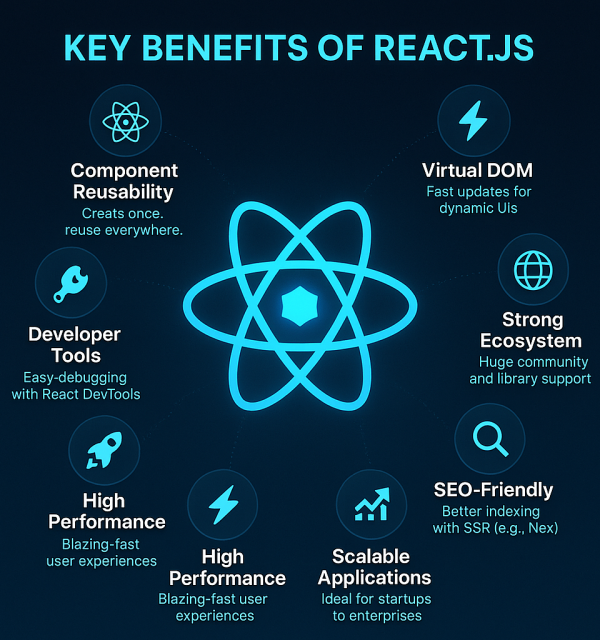
What is React js | 6 benefits | MyTeams
  • Component Reusability: Build once, use everywhere. Components can be reused across different parts of an application, saving time and maintaining consistency.


  • Virtual DOM for Speed: React’s virtual DOM updates only what’s necessary, leading to faster and more efficient app performance.


  • Strong Community and Ecosystem: With millions of developers using React, you’ll find plenty of libraries, tools, tutorials, and community support to solve almost any challenge.


  • Flexibility and Scalability: React works well with other libraries or frameworks (like Redux, Next.js) and scales easily as your project grows.


  • Rich Developer Tools: Browser extensions like React Developer Tools help debug and analyze React apps easily.


  • SEO-Friendly Features: When used with server-side rendering (like Next.js), React apps can be optimized for search engines better than traditional single-page apps.

How React.js Differs from Traditional JavaScript Development

React.js introduces a new way of building user interfaces compared to traditional JavaScript development methods. Here’s how they differ:

  • Direct DOM Manipulation vs. Virtual DOM:
    Traditional JavaScript and libraries like jQuery manipulate the browser’s DOM directly, which can become slow and error-prone with complex pages.
    React uses a virtual DOM, a lightweight copy of the real DOM, to update only the parts of the page that change, making performance much faster and smoother.


  • Imperative vs. Declarative Programming:
    In traditional JavaScript, you have to tell the browser how to change things step-by-step (imperative programming).
    In React, you describe what the UI should look like (declarative programming), and React handles the updates automatically.


  • Monolithic Code vs. Component-Based Architecture:
    Older approaches often involved mixing HTML, CSS, and JavaScript into large, tangled files.
    React encourages a component-based structure, where each UI part (like a button or a form) is a separate, reusable unit.


  • Event Handling Differences:
    Traditional JavaScript uses standard DOM event listeners scattered across the app.
    React centralizes event handling inside components, using a consistent, synthetic event system for better performance and easier debugging.


  • Scalability Challenges:
    As traditional apps grow, maintaining and scaling them becomes harder.
    React’s modular nature makes it easier to scale applications cleanly, even as they become very large and complex.

What is JSX and React js - The Role of JSX in React

JSX (JavaScript XML) is a key part of working with React, but it often confuses beginners at first glance. JSX allows you to write HTML-like syntax directly inside JavaScript files.

It looks like regular HTML, but under the hood, it gets transformed into JavaScript functions that create UI elements. JSX makes writing React components more intuitive and visually clear compared to using plain JavaScript React.createElement calls.

Here’s why JSX is so important in React development:

  • Readable Code: JSX makes your code easier to understand by visually resembling the final UI layout.
  • Seamless Integration: You can combine JavaScript logic and HTML structure in a single file, improving developer efficiency.
  • Powerful Expressions: You can embed JavaScript expressions inside {} curly braces directly in your markup.
  • Better Tooling and Error Messages: JSX allows React’s ecosystem (like Babel and ESLint) to provide better warnings, hints, and code validations.

While JSX is not mandatory for building React apps, it is the de facto standard because it saves time and reduces complexity when developing components and interfaces.


React.js

JSX

A JavaScript library for building user interfaces, especially single-page applications. It provides tools (components, hooks, state management, etc.) to build complex UIs.

A syntax extension for JavaScript. It looks like HTML or XML but is actually JavaScript under the hood. JSX is used inside React components to describe the UI structure.

Provides functionality like useState, useEffect, component lifecycle methods, virtual DOM, and more.

Provides a way to write UI markup in a way that’s readable and declarative inside React code.

Example: React.createElement(‘h1’, {}, ‘Hello’) creates a React element without JSX.

Example: <h1>Hello</h1> is the same as the above code but written using JSX for better readability.

You can technically write a full React app without JSX (just using plain React.createElement), but it’s tedious.

JSX needs to be transpiled (usually by Babel) into React.createElement calls before it runs in the browser.

Popular Use Cases and Companies Using React.js

React.js is not just popular among small projects — it powers some of the world’s biggest and most demanding applications. Its flexibility, performance, and developer-friendly nature make it a top choice across industries like social media, e-commerce, entertainment, and enterprise software.

Here are some real-world use cases where React.js shines:

  • Single Page Applications (SPAs): Apps that load a single HTML page and dynamically update as users interact, such as dashboards and interactive web apps.
  • Mobile App Development: Using React Native, developers can create mobile apps for iOS and Android with the same principles as React.
  • Dynamic Websites: Content-heavy platforms like blogs, news sites, and portfolio websites use React for faster, more interactive experiences.
  • E-commerce Platforms: React allows for smooth, fast-loading shopping experiences that can increase customer engagement and conversions.
  • Enterprise Software Solutions: Large companies use React to build scalable internal tools, management platforms, and CRM systems.

Here are some major brands that use React.js in their web platforms:

  • Facebook: React was originally created for Facebook’s dynamic user interfaces.
  • Instagram: Built with React to handle millions of active users.
  • Airbnb: Uses React for its highly interactive booking and listing experiences.
  • Uber: Utilizes React to maintain its real-time maps and user experiences.

Why React.js is a Great Framework for Businesses

React.js offers businesses a powerful combination of speed, scalability, and flexibility. Its component-based architecture accelerates development by allowing code reuse across projects. 

The virtual DOM ensures that apps remain fast and responsive, even as they scale. React’s huge community support and rich ecosystem reduce development risks and provide faster solutions to problems. 

Additionally, React’s SEO-friendly capabilities, when combined with server-side rendering, help businesses improve their online visibility. Whether building a startup MVP or a full-scale enterprise app, React provides the tools needed to deliver exceptional user experiences and adapt quickly to changing market demands.

Conclusion

React.js continues to lead the way in modern web development, offering flexibility, performance, and a thriving ecosystem. Its component-driven approach, virtual DOM, and ease of scalability make it a powerful choice for businesses and developers alike. Whether you’re building a startup or a global platform, React provides the foundation for future-ready digital experiences.

Leave a Reply

Your email address will not be published. Required fields are marked *

Your Step-by-Step Guide to Building a Winning Minimum Viable Product | MyTeams

Your Step-by-Step Guide to Building a Winning Minimum Viable Product

By - MyTeams Editorial
What is App Store Optimization | MyTeams

What Is App Store Optimization – A Practical Guide To ASO in 2025

By - MyTeams Editorial

Thank You For Subscribing .