03 Jun 2025
If you thought “there’s an app for that” was a joke, think again.
By 2025, there’s an app for absolutely everything.
Need your fridge to sing lullabies? There’s probably an app. Want to send virtual high-fives to your cat? It’s out there.
With millions of apps flooding Apple’s App Store and Google Play, the market for mobile app development services is beyond crowded.
In fact, to say the app space is saturated is an understatement. For businesses, this raises a pressing question: in a world where every other company and their pet goldfish seems to have an app, how can you possibly stand out?
Don’t panic. We’re here to explore why the mobile app development services market is so saturated in 2025 and, more importantly, what businesses & entrepreneurs can do about it.
The mobile app boom of the 2010s has matured into a jam-packed digital bazaar by 2025. Both major app stores are teeming with software. The Apple App Store offers roughly 2 million apps, while Google Play hosts around 3 million apps for download. That’s not even counting the third-party app stores and the countless apps that never made it past beta.
This sheer volume means any new app is immediately one in a million, literally. As one industry site quipped, mobile app development is so saturated that calling it saturated “can prove to be an understatement.”
For some perspective on how crowded this field is, as of 2025, the Google Play Store had over 3.5 million apps available, yet only a “small fraction” of new apps ever achieved significant downloads.
In other words, competition is intense, and most apps struggle to gain traction. It’s not just apps that have proliferated; mobile app development companies have as well. There are millions of developers and publishers churning out new releases.
In fact, Google Play had about 2.87 million active publishers on its platform. With so many developers and firms offering mobile app development services, the barrier to entry for publishing an app is low, but the barrier to success is sky-high.
User behavior trends also confirm saturation. Nearly 98% of smartphone users use mobile apps regularly in 2023, yet the average user is downloading fewer new apps than before.
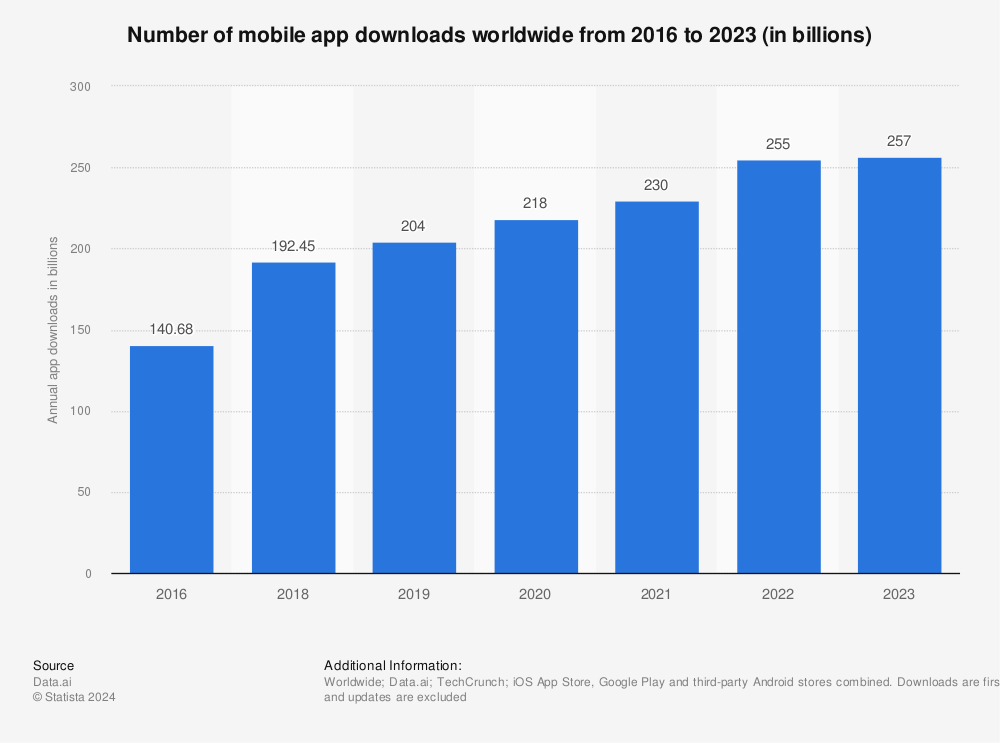
According to eMarketer research, the average smartphone owner in 2023 installed only about 18.5 apps in a year, which is 2.5 fewer apps than just a few years earlier. In markets like the US, essentially everyone who wants apps already has a phone full of favorites, and they’re not actively seeking new ones.
“Most new app users are new smartphone users” in emerging markets, notes the eMarketer report. In contrast, existing users have largely “settled on favorites” instead of exploring a zillion new apps. In plain English, users aren’t window-shopping for apps as much anymore. They have app fatigue. As eMarketer bluntly put it, in Western markets, “the problem is… too many apps.”
Even Gartner analysts foresee a possible decline in app usage ahead, predicting that AI digital assistants may cut mobile app usage by 25% by 2027 as consumers rely more on integrated services than standalone apps.
The saturation is evident in other sobering stats. Global app downloads actually declined in 2024 for the first time. One analysis found that total downloads dropped about 2.3% year-over-year, signaling that the era of heady growth has leveled off.
The app stores themselves are bursting at the seams. Thousands of new apps are added each day, and both Apple and Google have had to purge low-quality or duplicate apps to manage the bloat. Google’s crackdown on spam apps in 2024 led to a 60% reduction in new releases on the Play Store that year, highlighting just how much flotsam had accumulated.
The bottom line is that simply being on the app store is no guarantee that anyone will find you. It’s a needle-in-a-haystack situation if the haystack were 3 million pieces of hay and growing daily.
So how did we get here?
Understanding why the market is saturated can help businesses figure out how to navigate it. Here are the leading reasons the mobile app development service landscape looks like a packed house in 2025.
It bears repeating. There are millions of apps out there.
For any given idea, from calorie counters to meditation guides, there are dozens of alternatives available. The ease of accessing custom mobile app development services means any company or entrepreneur can launch an app.
Over the past decade, every business felt pressure to “get an app,” resulting in a glut of similar offerings. App stores are filled with lookalikes and clones of popular apps. Remember the flurry of Flappy Bird clones, anyone? This oversupply makes it incredibly tough for any single new app to gain visibility.
Unless your app cures boredom and washes the dishes, users have plenty of others to choose from.

Not only are there millions of apps, but also countless mobile app development companies and independent developers vying to create them. In other words, supply outstrips demand.
If an opportunity opens up, say a hot new game genre or a pandemic drives demand for video chat apps, dozens of teams will rush in. The result? Market saturation in nearly every app category.
A new company entering the fray is up against not just a few incumbents but potentially hundreds of competitors offering a similar mobile app development service or solution. For instance, in the crowded fintech space, established banks and startups alike have mobile apps. Good luck launching a new finance app without a very novel angle.
Even niche industries aren’t safe. Healthcare mobile app development services have produced countless fitness trackers, telemedicine apps, and patient portals, saturating that vertical. Similarly, fintech mobile app development services have churned out mobile wallets and trading apps aplenty.
In short, whatever your idea is, someone may have already built something like it.

With so many apps available, users have become picky and impatient. The novelty of “new app for X” is gone.
People stick to a core rotation of apps that serve their needs and are hesitant to try yet another one unless it seriously offers something better. In fact, many smartphone owners use only about 30 apps per month on average and just 10 apps per day. Getting into that rotation is an uphill battle.
Why download a new to-do list app, for example, when the one you have works fine?
This dynamic means the growth of app usage now comes mostly from new smartphone users or existing users consolidating around a few big “super-apps.” When Western users complain that there are “too many apps,” it indicates a saturated environment where pushing a new app onto their home screen may require displacing an existing favorite.

A saturated market breeds discerning customers.
With thousands of alternatives a tap away, users won’t tolerate subpar experiences. They expect slick performance, intuitive UX, and real value, or they’ll uninstall in a heartbeat. Studies show that 17% of users will abandon an app after just one bad experience, and a majority won’t give a new app a second chance if it disappoints.
By day 30 after installation, the average Android app retains a mere 2.1% of its users, and iOS apps only about 3.7%. In other words, almost 97-98% of users drop off within the first month if an app doesn’t immediately prove its worth. This harsh reality underscores how unforgiving the market has become. Users have zero patience for apps that are slow, buggy, confusing, or just not compelling.
High expectations extend across industries. For example, banking customers now demand flawless, feature-rich experiences, to the point that a 2024 Forrester review found consumers viewed most banks’ mobile apps as “largely undifferentiated” and not delivering distinct value.
With mobile app development services so widespread, users assume someone out there has a near-perfect app, and anything less will be deleted.
In a crowded app store, discovery is a massive challenge.
The days of an app going viral simply for being good are mostly over. Now, you often have to pay to acquire users or invest heavily in App Store Optimization (ASO) and marketing to get noticed. Many apps languish in obscurity not because they’re terrible but because users literally never see them.
With thousands of new apps launching daily, competition for eyeballs is fierce. Keywords, app store rankings, featuring on the top charts. These are battles that require strategy (and money). Cost-per-install (CPI) advertising rates have climbed as well, reflecting the intense competition for user acquisition. For example, in North America, the average CPI to acquire one new app user is around $5.28.
Globally, iOS user acquisition can cost in the range of $3–$4 per install, significantly more than Android. These rising costs mean bigger marketing budgets are needed to break through the noise, favoring larger players and leaving many indie apps invisible.
A mobile app development company services team might build you a fantastic app. However, without equal effort in marketing and ASO, it may still flop due to discoverability issues in this saturated arena. The mobile app market is saturated because everyone got the memo that apps are lucrative, leading to oversupply; meanwhile, users haven’t increased their appetite at the same pace. We have millions of apps chasing finite user attention. It’s the classic overcrowded gold rush: lots of prospectors, dwindling easy pickings.
But all is not lost. Saturation raises the bar for success. Businesses can still succeed in mobile app development in 2025; they need to be smarter and more strategic about it.
Let’s look at how.
Standing out in a saturated market is tough but not impossible.
Think of it like entering a packed stadium. If you want all eyes on you, you either need to put on one heck of a show or show up in a gorilla suit riding a unicycle, actually, don’t do that literally.
Here are some lucrative strategies for businesses looking to launch or grow an app in 2025 despite the saturation. These tips focus on differentiation, quality, and smart execution, the ingredients to make your app more than just another icon destined for the delete pile.
Before you write a single line of code, scour the landscape. Identify your potential competitors and substitutes; dozens of apps already address a similar problem.
Use that intel to find a gap you can exploit or a unique twist on the idea. In a saturated field, niche targeting can be your friend. For example, maybe there are many budgeting apps for general users, but few are personalized to freelance workers. That’s an opportunity.
Market research can also validate whether there’s actual demand for your app idea or if the market is over-served. The last thing you want is to invest in a product that ends up as the 101st app in its category, consider consulting with proof of concept services.
No, the world probably doesn’t need another generic to-do list app unless yours can literally teleport coffee to the user. Look at trends and user behavior data. If users are fatigued with certain app types, pivot to an approach that reignites interest. Essentially, be sure you know what you’re up against and what unique value you can offer before diving into development.
This might sound dramatic, but differentiation is absolutely critical in 2025.
If your app doesn’t have a clear, unique value proposition, it will drown in the sea of lookalikes. Ask yourself, what makes your app truly different or better than others in its category?
Maybe you offer a new feature, a smarter algorithm, a more personalized experience, or a focus on a specific sub-audience. It’s not enough to be slightly better. You need to stand out visibly. Notably, Forrester Research found that in sectors like banking, consumers can’t tell many apps apart; they viewed the major banks’ mobile apps as “largely undifferentiated.”
Don’t fall into that trap. It could mean focusing on a specialized domain. For instance, providing truly outstanding healthcare mobile app development services that address a unique medical need or an educational app that uses gamification in a novel way.
It could also mean branding and design that’s distinctive and memorable. Utilize custom mobile app development services to tailor the app exactly to your vision. Cookie-cutter solutions won’t cut it when users demand something fresh.
If you operate in a regulated or niche industry, leverage that. Apps that solve industry-specific pain points. For example, an app for farmers to monitor crops or a compliant solution via fintech mobile app development services for a new banking feature has built-in differentiation by serving needs others overlooked.
Make sure your app can answer the user’s question: “Why should I install this app instead of keeping the one I already have?” If you don’t have a darn good answer, go back to the drawing board until you do.

In a saturated market, user experience is the battlefield on which apps win or lose.
Given the slim tolerance users have, you need to deliver a smooth, delightful, and reliable experience from the get-go. This means investing in good UI/UX design and thorough testing; no one likes crashes on launch and performance optimization.
Remember that stat, “By day 30, you might lose ~97% of users if you haven’t wowed them.” So, aim to wow them immediately. Simplify your onboarding – users should grasp the value quickly without frustration.
As PwC famously noted, 59% of consumers will walk away after a few bad experiences and 17% after just one. The lesson for app makers: you probably won’t get a second chance to fix a poor first impression. Make responsiveness, clarity, and stability top priorities. Even little details like faster load times or a more attractive color scheme can make a difference in keeping users engaged.
If you’re working with a development partner, ensure that the mobile app development services company has a strong track record in UX/UI and quality assurance. Quality also extends to content, keeping your app’s content or data accurate and up-to-date. Basically, it should be the app that users love to use because it’s intuitive and reliable, not the one they curse under their breath. Great UX can turn even a “boring” utility app into something people rely on daily.
Another way to get more bang for your buck in a saturated market is to maximize your reach without reinventing the wheel for each platform. In 2025, developing your app for both iOS and Android is almost a must. If you want to cover a broad audience, why cut off half the potential users?
Companies often leverage cross-platform mobile app development services to build apps that work on multiple platforms from one codebase (using frameworks like React Native or Flutter). This approach can save time and ensure consistency across devices.
Similarly, hybrid mobile app development services allow the creation of apps that combine the best of web and native features, potentially reaching users via app stores and the mobile web. Depending on your target audience, you might prioritize one platform first. For example, using iOS mobile app development services to launch on iPhone if your user demographics skew towards Apple devices or focusing on Android mobile app development services for markets where Android dominates.
However, the end goal should be to have a presence wherever your users are, be it iPhone, Android, tablets, or even a web app for those who resist downloads. Cross-platform strategies also help reduce development costs, which is important in an environment where you need to allocate budget to marketing and updates, too.
Just be careful. Whether you go native or cross-platform, don’t sacrifice quality. Users can sniff out a poorly executed port in seconds. The good news is that modern cross-platform tools have matured to deliver near-native performance and UI.
The “build it, and they will come” mantra does not apply to mobile apps in 2025. In a saturated market, you have to fight for every user. This means dedicating resources to marketing, promotion, and app store visibility.
Start with ASO. Optimize your app listing with relevant keywords, compelling descriptions, and eye-catching screenshots & videos. This improves the odds of being discovered organically. Given that thousands of apps launch every day, even good ASO is akin to SEO in a very competitive Google search.
So, explore other marketing channels. Social media campaigns, partnerships, influencer marketing, content marketing, etc. If budget permits, invest in targeted user acquisition campaigns on platforms like Facebook, Google Ads, or app ad networks. But keep an eye on that Cost Per Install. With CPI averaging around $3–$5 in many cases, you want to attract the right users who will stick around, not just any users.
Leverage analytics to figure out which channels bring you users that engage vs. those who install and vanish. Also, consider timing and PR. Launching around a major industry event or getting press coverage can give you an early boost of users and credibility.
In a saturated market, marketing can be as important as the development itself. It’s how you make sure your superior app actually gets a chance to prove its superiority to users. Think of it as making sure your proverbial unicycle-riding gorilla is entering from center stage with a spotlight, not quietly from the side.
Acquiring users is only half the battle; keeping them is where the war is won. In such a competitive environment, if you don’t engage your users, someone else’s app will. We saw how dismal average retention rates are; nearly all new users were gone in a month for many apps.
To beat those odds, proactively design for engagement. This can include a smooth onboarding that demonstrates value quickly, push notifications to bring users back with relevant updates or offers, in-app rewards or gamification elements to encourage regular use, and new content or features to prevent the app from feeling stale.
For example, some fitness apps keep users coming back by adding social challenges and badges; productivity apps might send friendly reminders that actually help users achieve their goals instead of just yelling, “Come back!”.
Regular updates are key. Show your user base that the app is alive and improving. Solicit feedback and actually act on it. Users who feel heard can become loyal advocates. Also, consider onboarding customer support or community features right into the app. If users can get help or connect with others through your app, they have more reasons to stick around.
Essentially, treat retention as a core feature, not an afterthought. Many mobile app development companies now emphasize retention-centric design, recognizing that long-term success = user loyalty. Remember, in a saturated market, a user deleting your app isn’t just a lost install; it’s a likely gain for a competitor. So fight churn as fiercely as you make an acquisition.
One advantage of the app world in 2025 is the richness of data available. Use analytics tools to track how users are behaving in your app:
This data is a treasure map for improving your app post-launch. A/B test changes to see what moves the needle on engagement or conversion.
The idea is to iterate and fine-tune your app to meet users’ continuous needs better. The top apps in saturated categories often win because they never stop improving. Treat your app as a living product.
If something isn’t working, users hate a feature, or a funnel isn’t converting, be ready to pivot or overhaul it. In short, be agile and responsive. The companies that thrive in saturated markets are those that quickly adapt to user feedback and market trends. Flexibility can even lead you to unexpected success. Perhaps users use your app in a way you didn’t anticipate, revealing a niche you can double down on.
So, keep listening and keep optimizing.
This is a bit of a curveball, but in some cases, you might not need to build a native app at all to reach mobile users.
Progressive Web Apps (PWAs), for instance, can deliver app-like experiences via the mobile web without the friction of app store downloads. They’re not the solution for everyone, but for certain use cases, a PWA or other approach might achieve your goals with less competition.
Also, integrating with existing “super-apps” or platforms can be a strategy. For example, building a mini-app or service inside a larger ecosystem. The theme here is to think outside the box of the traditional app store model if necessary. That said, if having your app is critical, just be sure you’re choosing it for the right reasons and not because everyone else did. The key is delivering value to users on mobile; an app is one way, but not the only way.
Last but not least, businesses don’t have to go it alone. Given the complexity of succeeding in today’s mobile market, it can pay off to partner with experts. This might mean hiring a reputable mobile app development services company that brings experience from many past projects.
The right development partner can guide you on technical choices, UX best practices, and even strategy, helping you avoid common pitfalls. Likewise, consult with marketing experts or agencies who specialize in-app marketing. When evaluating any mobile app development company services, look for those that go beyond coding.
The best partners will care about your app’s business success, user research, monetization strategy, retention tactics, etc., in addition to clean code. Collaboration is key: your deep knowledge of your business domain plus your technical and market know-how is a powerful combination.
Also, consider strategic partnerships for distribution. For example, a cross-promotion deal with a non-competing app targeting a similar audience or integrations with popular services that can expose your app to more users. In 2025’s saturated market, who you know (or partner with) can be just as important as what you build. Smart businesses build an ecosystem of support around their app.
Yes, mobile app development services as a market are saturated in 2025. No point denying it.
The days of overnight app sensations are rare, and the competition looks like a thousand Spartans at the gate. But here’s the silver lining: saturation weeds out the mediocre. Users still crave great apps that solve real problems or delight them in new ways.
By differentiating your app, delivering top-notch quality, and executing intelligently, your business can absolutely carve out success even in this crowded arena.
So, go forth and build that amazing app. Just be sure to build it smarter than the rest. In a world of copycats and throwaways, be the app that users can’t live without.
After all, there’s always room at the top, even if the climb is crowded.